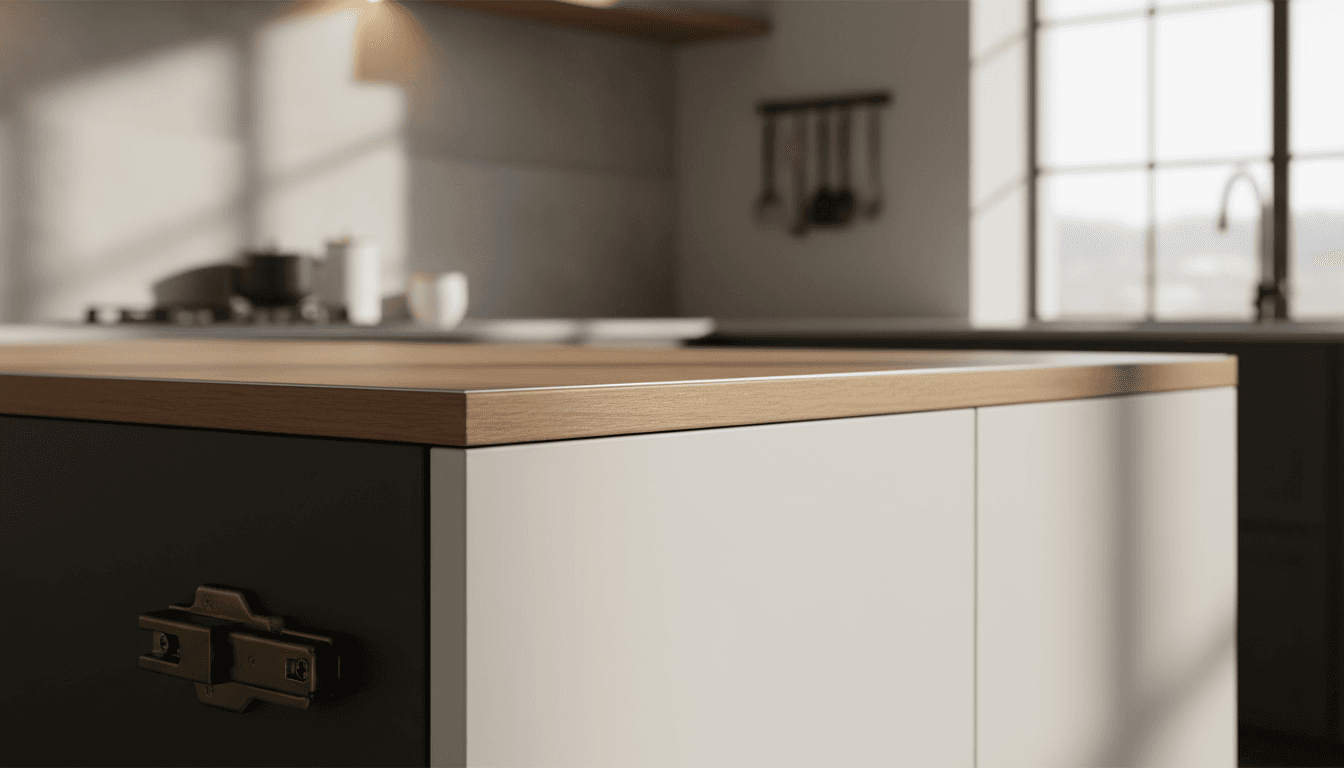
The biggest hesitation for customers considering membrane: “Will the foil eventually lift?” The industry had this issue with older membrane production, so the concern persists. At Vellora we've solved it in practice with PUR hot-melt + laser edge banding. Even so, it's only fair to explain the real conditions.
Where does peeling usually start?
The foil bonds to the entire door surface under vacuum press. Peeling starts at the edges in 95% of cases — particularly the inner-bottom edge (closest to water). Older systems used EVA glue, which softens above 70 °C with humidity, loosening the foil.
At Vellora we use PUR (polyurethane) hot-melt: heat-resistant up to 130 °C, water-impermeable. In 5 years of field records, we have zero edge-peeling reports on doors made this way.
Risk zones
- Next to a built-in oven: continuous 80 °C+ steam exposure. We recommend lacquer here, not membrane.
- Next to a dishwasher: if the appliance leaks hot steam, water can reach the door edge.
- Next to a wall-mounted boiler: the heat + humidity combination stresses the foil.
- High-steam range: if the extractor is undersized, long-term effects appear on the façade.
Solution: lacquer in the risk zones, membrane elsewhere. At Vellora, m² price is the same (1,350 TL), so there's no extra cost. Details: Lacquer or Membrane?.
Warranty coverage
Vellora gives a 5-year manufacturing warranty on membrane doors. Foil lifting, edge peeling, vacuum failure — anything caused by manufacturing during the product's service life — is replaced free of charge.
Outside warranty: deliberate scratches, heat exposure (e.g. oven door opening 5 cm from the cabinet), aggressive chemical cleaners, and prolonged soaking from in-home water leaks.
What if peeling occurs?
If you notice 1–2 mm of corner lift, take a photo and send it via WhatsApp to +90 544 673 84 34. The workshop team will assess; if it's a manufacturing fault, the door is replaced or repaired on-site.
If the damage is user-related (years of steam exposure, etc.), the workshop will offer paid repair or replacement. Door replacement is independent — the cabinet body is not disturbed.
Enter your size, get the price in seconds.
Lacquer and membrane same tariff. See the instant total in the configurator and decide.
Frequently Asked Questions
Does membrane really tolerate 70 °C?
The foil's standard spec is 70–75 °C. With Vellora's PUR adhesive + 1 mm thick edge banding, in practice it tolerates 90 °C. Even so, we recommend lacquer next to a continuous heat source.
Can I replace the doors after 10 years?
Yes — without disturbing the cabinet body, we can replace just the doors. Send the original dimensions and we'll produce new ones in the same model.
Does dish soap damage membrane?
Liquid dish soap is harmless. Chlorine-based cleaners (bleach, similar) and acetone are strictly off-limits. Wiping a stubborn grease stain with pure ethanol is safe.
How can I tell PUR from EVA glue?
Hard to tell visually. Ask for a certificate; the invoice/production report should specify PUR. Vellora uses PUR on every order; the product spec sheet is included with the order summary.
We make lacquer, membrane and wood cabinet doors at our Istanbul workshop. Articles distilled from field experience — no AI clichés, just practical knowledge from real customer reports.