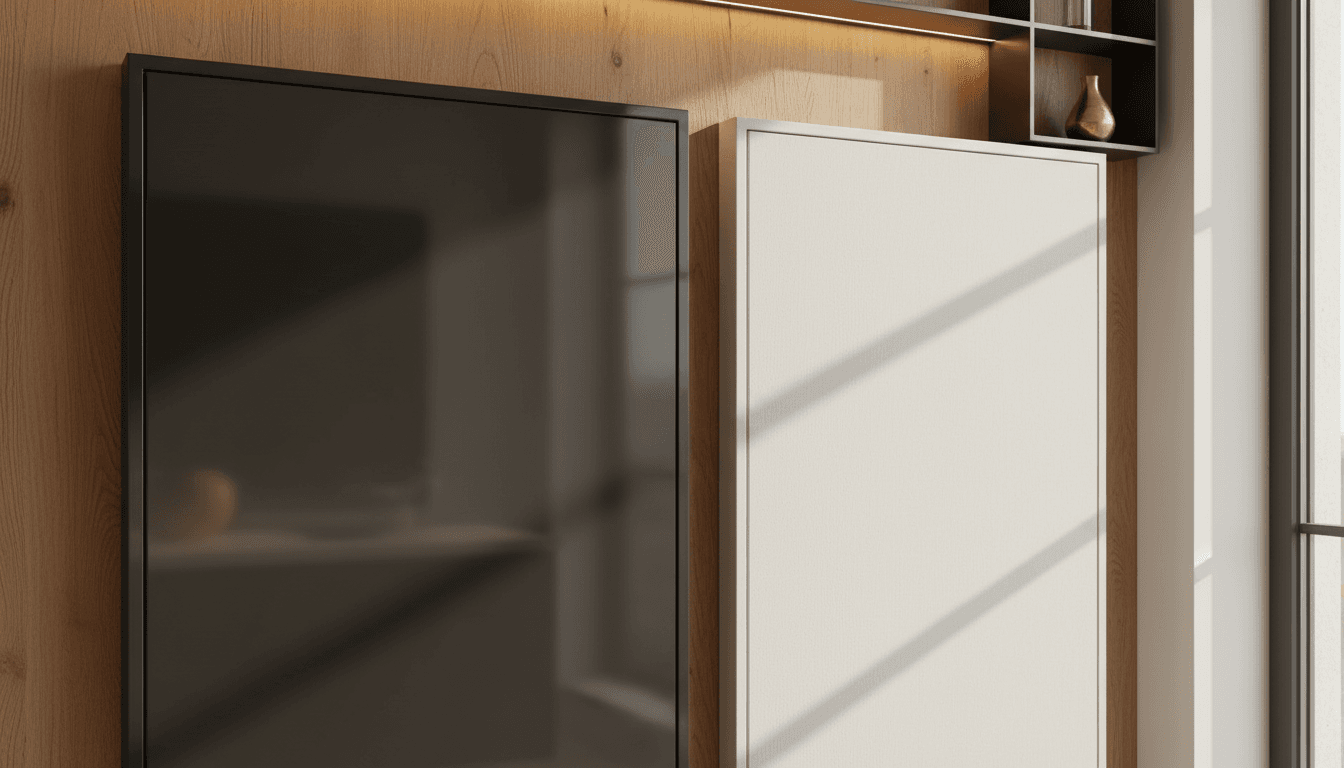
Half of the people who call us about a kitchen renovation start with the same sentence: “Should we go lacquer or membrane? We're confused.” What they read online contradicts itself, and there's a story going around that the prices differ. At Vellora, our m² price is the same for both finishes: 1,350 TL. So the choice is technical, not financial.
Below are 7 clear criteria distilled from 7 years of workshop and field experience. Each compares lacquer and membrane head-to-head; by the end of the article, the right call for your kitchen will be obvious.
1. Light reflection
Lacquer is finished with 5–7 layers of paint plus sanding plus polish, giving a near-mirror reflection. If your kitchen gets little daylight or is small, lacquer amplifies the sense of space. Membrane reflects matte or with a soft satin sheen; it absorbs light and reads as calmer.
Practical rule: in kitchens smaller than 12 m² and facing north, glossy lacquer adds light and openness. In wide, well-lit urban kitchens, matte membrane usually avoids unwanted glare.
2. Scratch resistance
Membrane has a PVC foil top layer that, until the foil itself wears, is highly scratch-resistant. Unless you deliberately drag a fork across it, no marks remain. Lacquer's polish is hard, but a sharp pencil tip can leave a faint trace, especially on matte lacquer.
Field observation: across 5 years of typical use, lacquer shows 2–3 minor marks; membrane shows almost none. Children at home, pets, very heavy use → membrane is the safer call.
3. Heat and humidity tolerance
Lacquer is stronger against heat. Right next to the stove, around the oven, near a coffee machine — anywhere that sees hot steam — lacquer holds up for years. Membrane has an upper limit of about 70–75 °C; cabinet fronts that take direct, continuous steam risk peeling at the edges.
Practical fix: we usually do most of the kitchen in membrane and combine 1–2 lacquer doors next to the built-in oven and stove. Same m² price, unified look. This combination is common at Vellora.
4. Maintenance and daily cleaning
Both: microfiber + warm water is enough. Glossy lacquer shows fingerprints, but they wipe off cleanly. Matte membrane hides fingerprints — parents specifically appreciate this. Abrasive sponges, steel wool, and chlorine-based cleaners are off-limits on both.
Workshop tip: monthly furniture polish is not necessary. For greasy stains, a cloth dampened with pure ethanol is enough. That's it.
5. Color accuracy and custom colors
Lacquer matches RAL codes to the millimeter; specific tones — grey-blue, taupe, custom shades — are mixed in the workshop. Membrane is selected from a pre-printed foil catalog; colors not in the catalog cannot be produced.
Decision: “I want to match this fabric, this marble countertop” → lacquer. Standard popular tones are enough → membrane is more practical.
6. Lead time
Same tariff, same m² price, but lead time differs. Membrane: typically 8–11 working days. Lacquer: 12–14 working days. Reason: lacquer needs mandatory drying intervals between coats; you can't rush it.
If a customer is in a rush, membrane is sometimes the deciding factor. If you're working to a two-week deadline, the workshop will give you an honest estimate at the first call.
7. Façade design feel
Glossy lacquer: modern, sharp, “premium showroom” feel. Matte lacquer: minimal, soft, timeless. Membrane: natural, lived-in, warm. Wood-pattern membrane is still extremely strong — separating it from real wood by sight is genuinely difficult.
If you still can't decide: the Vellora approach
Enter your dimensions in the configurator and you'll see lacquer and membrane priced identically (same m² price). To compare the actual surfaces, visit the workshop after booking — we keep small sample panels ready, comparing on-site takes 5 minutes.
Still on the fence? Message us on WhatsApp at +90 544 673 84 34. Send your dimensions and a kitchen photo, and our team will give a field recommendation: “lacquer here, membrane there.” Technical advice, not a sales pitch.
Enter your size, get the price in seconds.
Lacquer and membrane same tariff. See the instant total in the configurator and decide.
Frequently Asked Questions
Why are lacquer and membrane the same price at Vellora?
Single-tariff policy: 1,350 TL/m², regardless of finish. We wanted the customer's choice to be driven by technical fit, not price. Workshop effort differs, but scale absorbs it.
Are fingerprints a real problem with glossy lacquer?
Visible but not sticky. A microfiber cloth wipes them clean in 2 seconds. Matte lacquer hides fingerprints. In homes with kids, matte is the more common pick.
When does membrane peel?
Direct continuous steam (next to the oven, kettle, water heater) and water seeping under the foil edge are the two main causes. With our PUR hot-melt edge banding, 5 years of field reports show no peeling.
Does a half-lacquer half-membrane combination look odd?
No. Produced in the same color/pattern, the façade reads as a single piece. We'll do membrane where reflections bother you and lacquer in the hot zone — a common spec.
Which surface ages better at the 10-year mark?
With basic care, both go past 10 years. Heavily used doors typically wear out at the hinge and handle, not the surface. The cabinet body outlasts the door surface either way.
We make lacquer, membrane and wood cabinet doors at our Istanbul workshop. Articles distilled from field experience — no AI clichés, just practical knowledge from real customer reports.