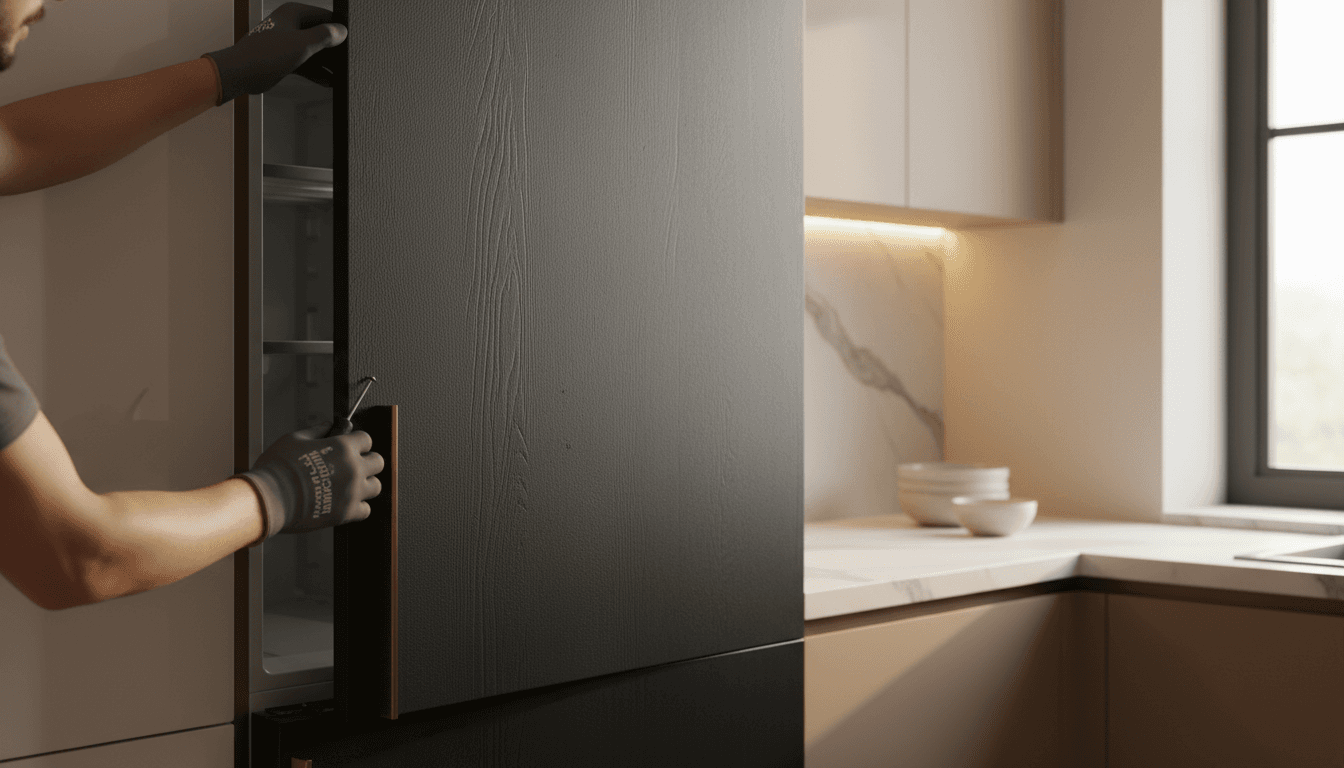
A built-in appliance is recessed into the kitchen façade with the same series of doors as the cabinets. A properly prepared panel hides the appliance and gives the kitchen a unified look. Done wrong, the door rattles when the appliance runs, sits out of alignment, and peels at the edges as it ages.
This article covers measurements, color and installation details for the 3 most common built-in appliances. These are the panels we produce most often at the workshop; with the spec sheet, we confirm within 24 hours.
Fridge panel (largest + most visible)
Typical built-in fridge: height 1,770–2,030 mm, width 540–560 mm. Two or three separate panels for the upper cooler and lower drawers; each gets soft-close hinges.
Watch the appliance spec sheet for “panel weight max” — most models cap at 25 kg. 18 mm MDF + lacquer/membrane averages 15–18 kg, within range. If a thicker panel (25 mm) is needed, check appliance compatibility.
Field tip: the fridge panel is the most visible piece on the kitchen façade. Lacquer (over membrane) gives a deeper color and premium feel. Midnight Blue Lacquer Built-in Panel was designed for this segment.
Dishwasher panel
60 cm standard, 45 cm slim. Height matches the under-counter level: 715–720 mm. Width 596 mm (for 60 cm appliance, including overlay) or 446 mm (for 45 cm).
Important detail on the dishwasher panel: a vibration-damping foam strip on the inside face. Without it, the door rattles during cycles. The workshop adds this strip as standard — no separate request needed.
Oven panel (heat tolerance)
Built-in oven panel: 60 cm standard, 45 cm mini, 90 cm wide. Specific dimensions come from the appliance. The critical issue here is heat tolerance: when the oven runs, the door heats up and steam escapes at the edges.
Use lacquer here, not membrane. Membrane softens at 70–75 °C; under continuous steam exposure, edge peeling becomes a risk. Lacquer tolerates 130 °C+, no issues. Details: Do membrane doors peel?.
Color + pattern matching
Built-in panels must come from the same series as the rest of the kitchen façade. Standard catalog colors hold consistently across separate production runs — no color drift.
If you're using wood-pattern membrane, all built-in panels should be from the same foil run — foil batches can show subtle tone differences. Vellora produces in single batches, so this issue doesn't arise.
Appliance choice → panel dimensions
Practical flow: pick the built-in appliances first (Bosch, Siemens, Whirlpool, etc.), send the spec sheets to the workshop, and panel dimensions are derived from those documents. If the appliance changes later, the panel may not fit.
If you can't decide, the workshop has compatibility tables for popular brands; send a model name on WhatsApp and we'll tell you the panel dimensions directly.
Enter your size, get the price in seconds.
Lacquer and membrane same tariff. See the instant total in the configurator and decide.
Frequently Asked Questions
Which appliances accept panels?
Built-in fridge, dishwasher, oven, microwave, wine cooler, warming drawer, hood (panel-ready models). The appliance spec must say “panel-ready” or “integrated”.
Can a built-in appliance stay visible without a panel?
Aesthetic decision. Panels are recommended for façade unity. Not mandatory in small kitchens; in modern showroom kitchens, exposing the appliances can also be a deliberate style.
Does the panel still fit if I change the appliance?
Same brand + same size series, yes. If you want a tight match to a specific dimension, finalize the appliance choice first so the panel can be sized to it.
Will the fridge panel collect frost?
Condensation risk drops if the appliance spec includes an anti-condensation strip. Otherwise the workshop can add 5 mm foam insulation to the back of the MDF.
Are hood panels possible?
Modern panel-ready hoods exist. A panel can be fitted on the front cover (the one hiding the filter). If the appliance spec supports it, the workshop produces in the right dimension.
We make lacquer, membrane and wood cabinet doors at our Istanbul workshop. Articles distilled from field experience — no AI clichés, just practical knowledge from real customer reports.