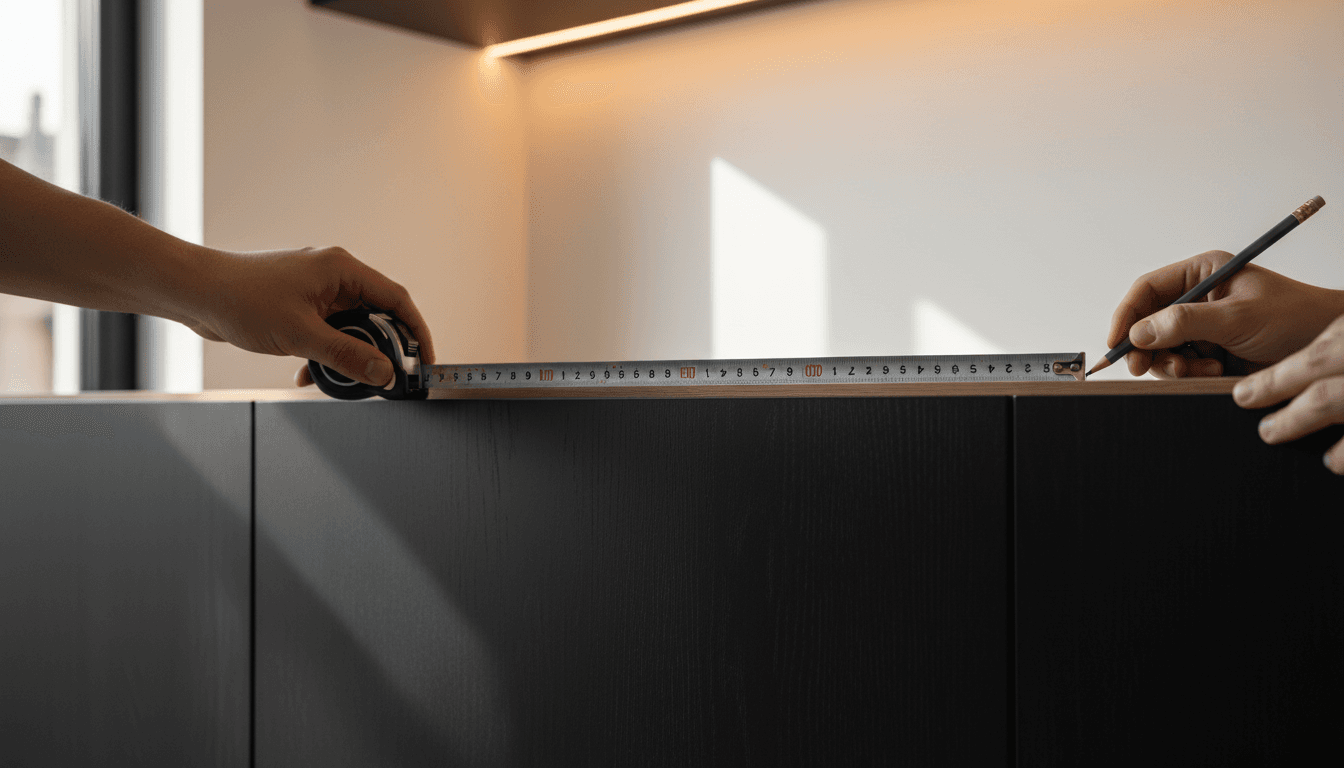
Measuring a cabinet door looks harder than it actually is — but customers who measure from the wrong point, miscalculate, or measure only once end up disappointed when their order arrives. We've collected the mistakes we've seen at the workshop over the years; the 8 steps below prevent every one of them.
You only need one tool: a metal tape measure (3 m, marked in millimeters). Don't use plastic or fabric tape — the deviation can hit 2–3 mm, which becomes visible on the door.
1. Decide what you're measuring: new build or replacement?
Replacing an existing door: take the old door off, lay it flat, and measure width and height side by side. We reproduce that exact dimension.
Measuring for new production (empty frame, no old door): measure the inner frame opening, then add 2 mm overlay per side. Standard overlay is 4 mm (half) or 8 mm (full). The hinge type determines the overlay.
2. Width: the short edge, left to right
Measure the horizontal opening at three points: bottom, middle, top. If they differ, write down the smallest. Kitchen walls are rarely perfectly square; a 5 mm difference is normal.
Result, e.g. 396 mm. Send that to the workshop as is. We handle the overlay calculation — you give us the opening.
3. Height: the long edge, bottom to top
Same idea, three points: left, center, right. Write the smallest. Standard cabinet doors are 600–720 mm; tall doors are 1800–2400 mm. For anything over 2 m, measure at five points — the wall may bow.
On tall doors, floor slope matters. Floors can have up to 8–10 mm slope; we use the shortest measurement as the reference so the slope doesn't show.
4. Overlay type: half, full, or inset?
The most common in Turkey is half overlay: each door covers half the cabinet side, leaving 4 mm between doors. Standard for modular kitchens.
Full overlay covers the side panel entirely. Inset (vintage) sits inside the frame; rare in current builds. We can identify the type from the hinge — send a photo.
5. Frame clearance and hinge cup positions
Standard Blum / Hettich / domestic hinges use a 35 mm cup; we drill the cup on the inside face. If the old door has hinges, measure the cup distance from the door edge and tell us — e.g. 75 mm from the top, 75 mm from the bottom.
If you want to relocate the hinge (was 80 mm from top, want 75 mm now), state it on the order. Otherwise we keep the original positions.
6. Tolerance: 3–5 mm safety margin
Standard rule for kitchen renovation: leave 3–5 mm tolerance. The Vellora workshop uses this margin during the final pass (planing, edge banding).
If you're confident, give the exact dimension. If you're unsure, order 2 mm small — it's better to adjust the gap during installation than to deal with one that's too large.
7. Multiple doors: write them in one table
For a 10-door kitchen, write a sheet (paper or Excel): A1 = 396×716, A2 = 396×716, B1 = 596×716… A clean, ordered list. Orders that arrive this way are confirmed within 24 hours; messy orders bounce back and forth for 2–3 days.
Include door position on the list (lower left, upper center, next to built-in oven, etc.). If finish or color differs, note it on that line.
8. When in doubt: photo + measurements
If you can't decide, send an interior kitchen photo + handwritten measurement sketch via WhatsApp. The workshop confirms within 1–2 hours and flags any missing data. Better than producing the wrong piece.
Enter your size, get the price in seconds.
Lacquer and membrane same tariff. See the instant total in the configurator and decide.
Frequently Asked Questions
Can I replace existing doors without removing the cabinet body?
Yes — the cabinet bodies stay; only the doors are replaced. Take the old door off, measure it, and send the dimensions; the new doors mount to the same hinge cups. Typical install time: 1 hour.
Should the countertop sit at the same level as the door?
No, the countertop can sit 1–2 mm above the door. What matters is that the doors line up with each other. Treat countertop dimensions separately from door dimensions.
What if I send a wrong measurement?
We confirm before production starts; we catch 95% of errors in the first email exchange. If you spot the issue after delivery, unused product can be returned within 14 days. Production errors are on us; measurement errors get reworked at the workshop with minimum loss.
How do you keep millimetric alignment on tall doors?
On doors over 2 m, floor + ceiling slope is the biggest issue. We laser-level the wall and take an independent top measurement for each door. Discuss the details on WhatsApp; we'll prepare a photo-based field plan.
We make lacquer, membrane and wood cabinet doors at our Istanbul workshop. Articles distilled from field experience — no AI clichés, just practical knowledge from real customer reports.